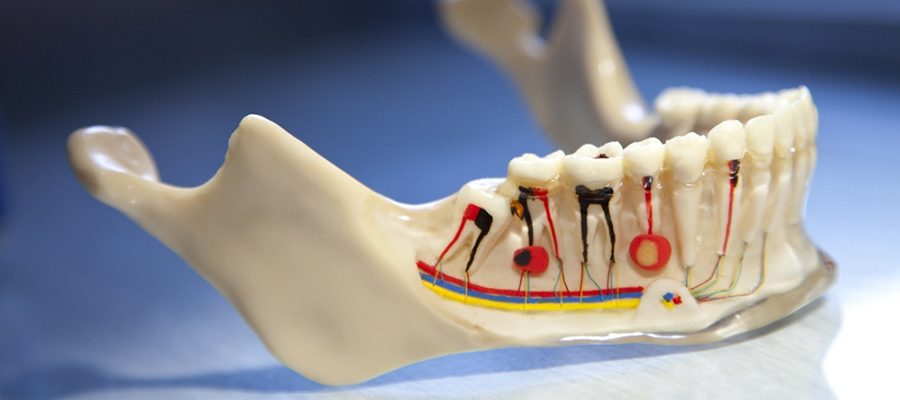
It is a treatment method applied in cases where the nerve (pulp) in the inner part of the tooth is damaged or dead due to reasons such as decay or trauma.
It is the process of removing the nerves inside the tooth, shaping the canals inside the tooth roots and purifying them from microorganisms and then filling the enlarged canals.
Then, restorations such as fillings, porcelain, crowns, inlays, etc. are applied to the upper part of the tooth according to the loss of material and the tooth is maintained aesthetically and functionally.
Why is root canal treatment performed?
It is performed in order to clean all the infected parts of the painful, inflamed, bad teeth that may be lost due to decay or trauma, to ensure that they remain in the mouth for a long time, and to prevent further treatments that may occur due to tooth loss, which will force you both financially and morally. The tooth remaining in the mouth after root canal treatment is dead in that area, but at least it will continue to help you chew as your own tooth, thus preventing the melting of the jaw bones by keeping the bone in that area active.
How long does a root canal treated tooth last?
Root canal treatment is a treatment to prevent tooth extraction and gives the tooth its last chance. As a result of a root canal treatment performed under appropriate conditions, the tooth can function in the mouth for a lifetime. However, teeth with root canal treatment may be more fragile than natural teeth.
Are there any risks associated with root canal treatment?
The success rate of a root canal treatment performed properly and according to the rules is over 90% – 95% on average. In the event that the root canal instrument is broken in the root during treatment or the root canals cannot be cleaned completely (root blockage, etc.), root canal treatment is tried again, and if it is not successful, the tooth is tried to be saved with surgical methods.
How is root canal treatment performed and how long does it take?
The patient is anesthetized, the tooth decay is removed and a cavity is opened into the tooth. The pulp chamber is reached and the canals are entered from this part of the tooth with special tools and various procedures are applied and disinfected to clean them from bacteria, then the pulp chamber and canals are filled with various medications and closed with temporary filling. In some cases, canal treatment can be performed in a single session, while in abscessed, inflamed teeth, the treatment is prolonged as this situation is tried to be passed by making dressings. After the tooth heals, the root canal filling is completed. How long this period will be depends on the condition of your tooth.
Things to consider during root canal treatment.
Do not use your tooth to chew hard foods between root canal treatment sessions. Since your tooth has a temporary filling, your tooth may break. You may complain of pain between sessions, consult your dentist for dressing. Your face may swell between sessions. There is nothing to worry about, this is a reaction caused by microorganisms and is corrected with dressings. Inform your physician.
What happens after root canal treatment?
After your root canal treatment, you may complain of pain when you press on your tooth as the inflammation in the natural tissues will last for a few days. You should not load that area during this period. After a while, your complaint will go away and you can use painkillers recommended by your doctor if necessary. If this situation does not go away and continues to increase, consult your doctor about this issue. Since the teeth that have undergone root canal treatment lose their vitality, their flexibility decreases. Therefore, the risk of fracture afterwards is very high. Please take into account the recommendations of your dentist for the most appropriate restoration that will allow you to use this tooth for a long time. If there is no excessive loss of material on your tooth whose root canals are filled, normal filling is required, if there is excessive material loss, porcelain filling (inlay) is required to support your remaining tooth walls and prevent them from breaking in the future. If you have no tooth wall left, it is best to make a post supported by your root canal and crown over it. Root canal treatment is performed under local anesthesia and there is no pain. The root of the tooth in the jawbone is entered through a cavity (cavity) opened from the crown part of the tooth visible in the mouth to the nerve layer (pulp) of the tooth. The nerves of the tooth are located in the canals in the root part.